Send
Close Add comments:
(status displays here)
Got it! This site "creationpie.com" uses cookies. You consent to this by clicking on "Got it!" or by continuing to use this website. Note: This appears on each machine/browser from which this site is accessed.
Revelation 3:14-22 RC7 Laodicea
1. Revelation 3:14-22 RC7 Laodicea
2. Seven Churches in Revelation
Revelation 1:11 Saying, I am Alpha and Omega, the first and the last: and, What thou seest, write in a book, and send it unto the seven churches which are in Asia; unto Ephesus, and unto Smyrna, and unto Pergamos, and unto Thyatira, and unto Sardis, and unto Philadelphia, and unto Laodicea. [kjv]
The seven letters to the seven churches of Revelation were written, from Jesus through John (on the island Patmos), to
actual churches in Asia Minor (western Turkey today).
1. Ephesus: Revelation 2:1-7 RC1 Ephesus
2. Smyrna: Revelation 2:8-11 RC2 Smyrna
3. Pergamum/Pergamus: Revelation 2:12-17 RC3 Pergamus
4. Thyatira: Revelation 2:18-29 RC4 Thyatira
5: Sardus: Revelation 3:1-6 RC5 Sardus
6. Philadelphia : Revelation 3:7-13 RC6 Philadelphia
7. Laodicea: Revelation 3:14-22 RC7 Laodicea (this page)
3. Historical interpretation of church history
| Interpretations |
| ☐ Literal |
☐ Christian living |
| ☐ Figurative |
☐ Heresies over time |
| ☐ Historical |
☐ Prophetic details |
[spread spectrum communication] [self-similar like fractals] [linear combinations]
|
Note that the time of Roman persecutions was that of the universal church as a collection of small "mustard seeds" while the time of Roman acceptance was that of the universal church as "tree with birds making a home in the branches".
|
4. Historical interpretation of church history
| * |
Churches |
Parables |
Beatitudes |
Church ages |
| 1 |
Ephesus |
Sower |
Poor in Spirit |
Jesus and the Good News |
| 2 |
Smyrna |
Weeds |
They that mourn |
Roman persecutions |
| 3 |
Pergamus |
Mustard |
Meek inherit |
Roman acceptance |
| 4 |
Thyatira |
Leaven |
Hunger and thirst |
Catholic Church |
| 5 |
Sardis |
Treasure |
Merciful and alms |
Protestant Reformation |
| 6 |
Philadelphia |
Pearl |
Pure in heart |
Great Awakenings |
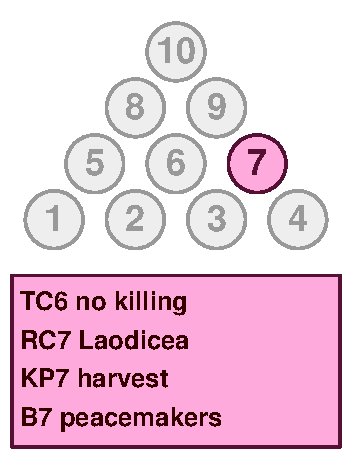
| 7 |
Laodicea |
Harvest |
Peacemakers |
Apostate church age |
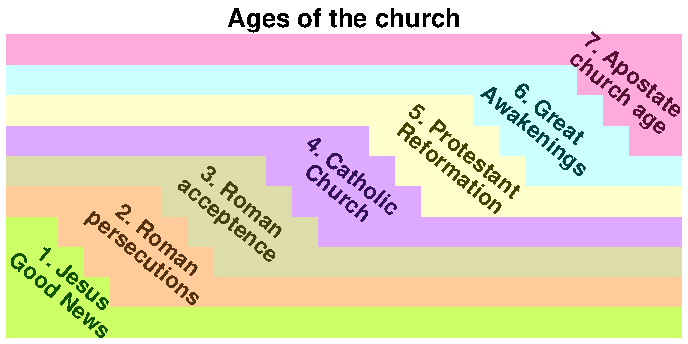
If you do not like the historical interpretation, as prophecy, just use the model to remember the order of the Churches, Parables and Beatitudes.
[spread spectrum communication] [self-similar like fractals]
5. Revelation 3:14-22 RC7 Laodicea
Revelation 3:14 And unto the angel of the church of the Laodiceans write; These things saith the Amen, the faithful and true witness, the beginning of the creation of God; [kjv]
και τω αγγελω της εν λαοδικεια εκκλησιας λαοδικεων γραψον ταδε λεγει ο αμην ο μαρτυς ο πιστος και ο αληθινος η αρχη της κτισεως του θεου [gnt]
Laodicea is the
last of the
seven churches to receive letters from Jesus through John in Revelation.
Why would Jesus say what he says?
He is "faithful". Have they been "faithful"? To what are they "faithful"?
He is "true". Have they been "true"? To what are they "true"?
6. Stair analogy

A
stair analogy can be used to help understand
top-down design and
bottom-up implementation.
The goal is the top of the stairs.
The start is the bottom of the stairs.
Identifying the
goal is most important! You do not want to climb the wrong stairs to get to the wrong goal.
Implementation:
Do it: 1 to 2 to 3 to 4 to 5 (same either way)
Design: When it works,
top-down tends to be
better.
Think bottom-up: 1 then 2 then 3 then 4 then 5 (start forward to goal)
Think top-down: 5 if 4 if 3 if 2 if 1 (goal backward to start)
Gospels:
Bottom-up: Matthew, Mark, Luke (goal not clear, a lot of extra material)
Top-down: John (goal clear, no extra material)
7. In the beginning
Genesis 1:1 In the beginning God created the heaven and the earth. [kjv]
Which verse at the beginning of John corresponds to Genesis 1:1?
John 1:1 In the beginning was the Word, and the Word was with God, and the Word was God. [kjv]
1:2 The same was in the beginning with God. [kjv]
1:3 All things were made by him; and without him was not any thing made that was made. [kjv]
1:4 In him was life; and the life was the light of men. [kjv]
8. Revelation 3:14
Revelation 3:14 And unto the angel of the church of the Laodiceans write; These things saith the Amen, the faithful and true witness, the beginning of the creation of God; [kjv]
και τω αγγελω της εν λαοδικεια εκκλησιας λαοδικεων γραψον ταδε λεγει ο αμην ο μαρτυς ο πιστος και ο αληθινος η αρχη της κτισεως του θεου [gnt]
How does
Laodicea relate to the
"beginning" of the
"creation" of "
God"?
The
ancient Greek word
"κτίζω" ≈ "to people, to found, to create/produce".
This is just the
"beginning". The
ancient Greek word
"ἀρχή" ≈ "beginning, origin, sovereignty, authority" and could be the end of a rope, stick, etc., or the corner of a sheet. In context, it could be a
"rule". To accurately "
measure" with a
"ruler" you need to
persistently stick to it.
In a top-down design, Laodicea would be at the start of the design.
9. Revelation 3:14 And burn
Revelation 3:14 And unto the angel of the church of the Laodiceans write; These things saith the Amen, the faithful and true witness, the beginning of the creation of God; [kjv]
και τω αγγελω της εν λαοδικεια εκκλησιας λαοδικεων γραψον ταδε λεγει ο αμην ο μαρτυς ο πιστος και ο αληθινος η αρχη της κτισεως του θεου [gnt]
… angelo Laodiciae ecclesiae scribe … Amen testis fidelis et verus qui est principium creaturae Dei [v]
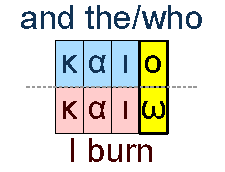
"και" ≈ "and" and "ο" ≈ "one".
"καίω" ≈ "(I) burn".
Does the play on words fit here?
The
KJV (King James Version) omits the
Greek definite article
"the" before
"true" and moves the
"true" to
before the
"and".
Latin had
no definite article. Why might Jesus have included the
"the"?
10. Revelation 3:14 Beginning
Revelation 3:14 And unto the angel of the church of the Laodiceans write; These things saith the Amen, the faithful and true witness, the beginning of the creation of God; [kjv]
και τω αγγελω της εν λαοδικεια εκκλησιας λαοδικεων γραψον ταδε λεγει ο αμην ο μαρτυς ο πιστος και ο αληθινος η αρχη της κτισεως του θεου [gnt]
The
ancient Greek word
"ἀρχή" ≈ "beginning, origin, sovereignty, authority" and could be the end of a rope, stick, etc., or the corner of a sheet. In context, it could be a
"rule". To accurately "
measure" with a
"ruler" you need to
persistently stick to it.
11. Revelation 3:14 Creation
12. Revelation 3:14 Word order
Revelation 3:14 And unto the angel of the church of the Laodiceans write; These things saith the Amen, the faithful and true witness, the beginning of the creation of God; [kjv]
και τω αγγελω της εν λαοδικεια εκκλησιας λαοδικεων γραψον ταδε λεγει ο αμην ο μαρτυς ο πιστος και ο αληθινος η αρχη της κτισεως του θεου [gnt]
… angelo Laodiciae ecclesiae scribe … Amen testis fidelis et verus qui est principium creaturae Dei [v]
Greek word order:
... says the amen the witness the faithful and the true the beginning of the creation of the God.
Why was
"the" and
"true" moved before the
"and"?
In this case, the Latin follows the Greek word order - except that Latin does not have a definite article.
13. Revelation 3:14
KJV: And unto the angel of the church of the Laodiceans write; These things saith the Amen, the faithful and true witness, the beginning of the creation of God;
Greek: και τω αγγελω της εν λαοδικεια εκκλησιας λαοδικεων γραψον ταδε λεγει ο αμην ο μαρτυς ο πιστος και ο αληθινος η αρχη της κτισεως του θεου
Latin: et angelo Laodiciae ecclesiae scribe haec dicit Amen testis fidelis et verus qui est principium creaturae Dei
14. Revelation 3:15-16 Zesty hot and frigid cold
Revelation 3:15 I know thy works, that thou art neither cold nor hot: I would thou wert cold or hot. [kjv]
οιδα σου τα εργα οτι ουτε ψυχρος ει ουτε ζεστος οφελον ψυχρος ειης ης η ζεστος [gnt]
3:16 So then because thou art lukewarm, and neither cold nor hot, I will spue thee out of my mouth. [kjv]
ουτως οτι χλιαρος ει και ουτε ψυχρος ουτε ζεστος ουτε ψυχρος μελλω σε εμεσαι εκ του στοματος μου [gnt]
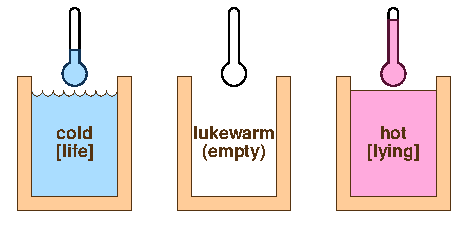
Jesus would prefer that the church at Laodicea be either
"cold" or
"hot" , both easily decidable, rather than
"lukewarm", neither
"cold" nor
"hot". Are
both "hot" and
"cold" good? This can be
literally true as in hot/cold tea, coffee, etc.
Are their "
works"
good? Might they think they are?
15. Revelation 3:15 English and German
Revelation 3:15 I know thy works, that thou art neither cold nor hot: I would thou wert cold or hot. [kjv]
… werkis… cold… hoot… could… hoot… [wy]
… workes … colde … hot… colde … hotte. [ty]
… Werke… kalt … warm … kalt … warm … [lu]
Note the variations of
"cold" and
"hot" in the
Wycliffe and
Tyndale versions.
16. Revelation 3:16
Revelation 3:16 So then because thou art lukewarm, and neither cold nor hot, I will spue thee out of my mouth. [kjv]
… lew… cold… hoot… [wy]
… bitwene bothe … colde … hot … [ty]
… lau … kalt … warm… Munde. [lu]
Wycliffe: cold, hoot, could, hoot, lew.
Tyndale: colde, hot, cold, hotte, bitwene bothe.
The German words "kalt" ≈ "cold" and "warm" ≈ "hot", "lau" ≈ "lukewarm, tepid", "lauwarm" ≈ "lukewarm, tepid".
17. Revelation 3:15-16 Latin
Revelation 3:15 I know thy works, that thou art neither cold nor hot: I would thou wert cold or hot. [kjv]
scio opera tua quia neque frigidus es neque calidus utinam frigidus esses aut calidus [v]
3:16 So then because thou art lukewarm, and neither cold nor hot, I will spue thee out of my mouth. [kjv]
… tepidus … frigidus … calidus … [v]
The Latin word
"fridigus" ≈ "cold" and is the source of the English word
"frigid".
The Latin word
"calidus" ≈ "warm, hot".
The Latin word
"tepidus" ≈ "lukewarm, tepid" and is the source of the English word
"tepid".
The
modern Greek word
"ζεστός" (zeh-STOS) ≈ "hot".
18. Hot springs
Revelation 3:16 So then because thou art lukewarm, and neither cold nor hot, I will spue thee out of my mouth. [kjv]
ουτως οτι χλιαρος ει και ουτε ψυχρος ουτε ζεστος ουτε ψυχρος μελλω σε εμεσαι εκ του στοματος μου [gnt]
The "
hot springs" in
Hierapolis (to the north of
Laodicea) are alluded to by Jesus in Revelation 3. This is the literal view which could be a distractor.
Colossae, to the south, had cold springs, from which an aqueduct brought cold water to
Laodicea that was then somewhat lukewarm.
"Hot" is often good (coffee, cocoa, etc.).
"Cold" is often good (coffee, cocoa, etc.).
"Lukewarm" is "tepid" and tends to be not good.
Are there exceptions to this rule? Why might this be claimed?
19. Revelation and Laodicea
Revelation 3:16 So then because thou art lukewarm, and neither cold nor hot, I will spue thee out of my mouth. [kjv]
ουτως οτι χλιαρος ει και ουτε ψυχρος ουτε ζεστος ουτε ψυχρος μελλω σε εμεσαι εκ του στοματος μου [gnt]

Consider what Jesus said to the Church at Laodicea as far as being "
yes" or "
no", as in
"hot" or
"cold". There are (at least) two ways to take what Jesus said.
Impose the current view that "hot" means doing what Jesus wants (as in "on fire" for the Lord) and "cold" means not doing what Jesus wants (as in a "cold shoulder"). That leaves the "lukewarm" meaning somewhat unclear.
Take both being "refreshing" (as were the cold and hot water sources at Laodicea) and "lukewarm", as not refreshing, being what is to be avoided.
20. Revelation 3:15 Or
Revelation 3:15 I know thy works, that thou art neither cold nor hot: I would thou wert cold or hot. [kjv]
οιδα σου τα εργα οτι ουτε ψυχρος ει ουτε ζεστος οφελον ψυχρος ειης ης η ζεστος [gnt]
This appears to be an
exclusive or since one cannot be literally both
"cold" and
"hot" at the same time.
"εἶ" ≈ "you are".
"εί" ≈ "if, whether".
21. Revelation 3:15
KJV: I know thy works, that thou art neither cold nor hot: I would thou wert cold or hot.
Greek: οιδα σου τα εργα οτι ουτε ψυχρος ει ουτε ζεστος οφελον ψυχροςειης ης η ζεστος
Latin: scio opera tua quia neque frigidus es neque calidus utinam frigidus esses aut calidus
Wycliffe: I woot thi werkis, for nether thou art cold, nether thou art hoot; Y wolde that thou were could, ethir hoot;
Tyndale: I knowe thy workes yt thou arte nether colde nor hot: I wolde thou were colde or hotte.
Luther: Ich weiß deine Werke, daß du weder kalt noch warm bist. Ach, daß du kalt oder warm wärest!
Russian: знаю твои дела; ты ни холоден, ни горяч; о, если бы ты был холоден, или горяч!
22. Revelation 3:16
Revelation 3:16 So then because thou art lukewarm, and neither cold nor hot, I will spue thee out of my mouth. [kjv]
ουτως οτι χλιαρος ει και ουτε ψυχρος ουτε ζεστος ουτε ψυχρος μελλω σε εμεσαι εκ του στοματος μου [gnt]
What is meant by
"mouth"?
The
ancient Greek word
"στόμα" ≈ "opening, mouth" and is the source of the English word "
stomach" (that which contains food entering from the mouth). The English medical term
"stoma" refers to an
"opening". The
modern Greek word
"στόμα" (STO-ma) ≈ "mouth, person".
23. Revelation 3:16
KJV: So then because thou art lukewarm, and neither cold nor hot, I will spue thee out of my mouth.
Greek: ουτως οτι χλιαρος ει και ουτε ψυχρος ουτε ζεστος ουτε ψυχρος μελλω σε εμεσαι εκ του στοματος μου
Latin: sed quia tepidus es et nec frigidus nec calidus incipiam te evomere ex ore meo
Wycliffe: but for thou art lew, and nether cold, nether hoot, Y schal bigynne to caste thee out of my mouth.
Tyndale: So then because thou arte bitwene bothe and nether colde ner hot I will spew ye oute of my mouth:
Luther: Weil du aber lau bist und weder kalt noch warm, werde ich dich ausspeien aus meinem Munde.
Russian: Но, как ты тепл, а не горяч и не холоден, то извергну тебя из уст Моих.
24. Revelation 3:17
Revelation 3:17 Because thou sayest, I am rich, and increased with goods, and have need of nothing; and knowest not that thou art wretched, and miserable, and poor, and blind, and naked: [kjv]
οτι λεγεις οτι πλουσιος ειμι και πεπλουτηκα και ουδενος ουδεν χρειαν εχω και ουκ οιδας οτι συ ει ο ταλαιπωρος και ελεεινος και πτωχος και τυφλος και γυμνος [gnt]
"τυφλός" ≈ "blind, dark, unseen"
"πτωχός" ≈ "beggar"
The
ancient Greek word
"τυφλός" ≈ "blind, dark, unseen" and is related to the English word
"deaf" and the
German word
"taub" ≈ "deaf".
25. Revelation 3:17
KJV: Because thou sayest, I am rich, and increased with goods, and have need of nothing; and knowest not that thou art wretched, and miserable, and poor, and blind, and naked:
Greek: οτι λεγεις οτι πλουσιος ειμι και πεπλουτηκα και ουδενος ουδεν χρειαν εχω και ουκ οιδας οτι συ ει ο ταλαιπωρος και ελεεινος και πτωχος και τυφλος και γυμνος
26. Revelation 3:18
Revelation 3:18 I counsel thee to buy of me gold tried in the fire, that thou mayest be rich; and white raiment, that thou mayest be clothed, and that the shame of thy nakedness do not appear; and anoint thine eyes with eyesalve, that thou mayest see. [kjv]
συμβουλευω σοι αγορασαι παρ εμου χρυσιον πεπυρωμενον εκ πυρος ινα πλουτησης και ιματια λευκα ινα περιβαλη και μη φανερωθη η αισχυνη της γυμνοτητος σου και κολλουριον εγχρισον εγχρισαι τους οφθαλμους σου ινα βλεπης [gnt]
27. Revelation 3:18
KJV: I counsel thee to buy of me gold tried in the fire, that thou mayest be rich; and white raiment, that thou mayest be clothed, and that the shame of thy nakedness do not appear; and anoint thine eyes with eyesalve, that thou mayest see.
Greek: συμβουλευω σοι αγορασαι παρ εμου χρυσιον πεπυρωμενον εκ πυρος ινα πλουτησης και ιματια λευκα ινα περιβαλη και μη φανερωθη η αισχυνη της γυμνοτητος σου και κολλουριον εγχρισον εγχρισαι τους οφθαλμους σου ινα βλεπης
28. Revelation 3:19
29. Laodicea
Revelation 3:19 As many as I love, I rebuke and chasten: be zealous therefore, and repent. [kjv]
εγω οσους εαν φιλω ελεγχω και παιδευω ζηλωσον ζηλευε ουν και μετανοησον [gnt]
3:20 Behold, I stand at the door, and knock: if any man hear my voice, and open the door, I will come in to him, and will sup with him, and he with me. [kjv]
ιδου εστηκα επι την θυραν και κρουω εαν τις ακουση της φωνης μου και ανοιξη την θυραν εισελευσομαι προς αυτον και δειπνησω μετ αυτου και αυτος μετ εμου [gnt]
In Revelation, to the apostate church at Laodicea, where Jesus has to knock on the door because he is not allowed in, we have the following verse.
30. Revelation 3:19
KJV: As many as I love, I rebuke and chasten: be zealous therefore, and repent.
Greek: εγω οσους εαν φιλω ελεγχω και παιδευω ζηλωσον ζηλευε ουν και μετανοησον
Wycliffe: Y repreue, and chastise whom Y loue; therfor sue thou goode men, and do penaunce.
Tyndale: As many as I love I rebuke and chasten. Be fervent therfore and repet.
31. Revelation 3:19
KJV: As many as I love, I rebuke and chasten: be zealous therefore, and repent.
Greek: εγω οσους εαν φιλω ελεγχω και παιδευω ζηλωσον ζηλευε ουν και μετανοησον
32. Revelation 3:20 Jesus at the door
Revelation 3:20 Behold, I stand at the door, and knock: if any man hear my voice, and open the door, I will come in to him, and will sup with him, and he with me. [kjv]
ιδου εστηκα επι την θυραν και κρουω εαν τις ακουση της φωνης μου και ανοιξη την θυραν εισελευσομαι προς αυτον και δειπνησω μετ αυτου και αυτος μετ εμου [gnt]
Some churches only allow the part of Jesus they like into their church. The church at
Laodicia appears to not want Jesus in their church. Jesus is at the church door knocking. [prize for knock-knock jokes]
Have some churches today "separated" or "uprooted" themselves from (the love of) Jesus?
Are some churches today "strangers" to Jesus?
Are some churches today "blind" to the true and complete Jesus?
Might those in this church be too busy "
ministering" to
others (goats) and not "
examining" or "
thinking" about the entirety of Jesus (sheep)?
The "
hear" in Greek has a connotation of hearing with understanding. The Greek for "
voice" is, literally, "
light" into the "
mind" and can be a play on words with "
murders".
[Wesley's Preveniant Grace, Matthew at the foot of the door]
33. Revelation 3:20
KJV: Behold, I stand at the door, and knock: if any man hear my voice, and open the door, I will come in to him, and will sup with him, and he with me.
Greek: ιδου εστηκα επι την θυραν και κρουω εαν τις ακουση της φωνης μου και ανοιξη την θυραν εισελευσομαι προς αυτον και δειπνησω μετ αυτου και αυτος μετ εμου
34. Revelation 3:21
Revelation 3:21 To him that overcometh will I grant to sit with me in my throne, even as I also overcame, and am set down with my Father in his throne. [kjv]
ο νικων δωσω αυτω καθισαι μετ εμου εν τω θρονω μου ως καγω ενικησα και εκαθισα μετα του πατρος μου εν τω θρονω αυτου [gnt]
How does one sit "
in" a "
throne"? Perhaps a "
throne" is more than something on which one "
sits".
35. Revelation 3:21
KJV: To him that overcometh will I grant to sit with me in my throne, even as I also overcame, and am set down with my Father in his throne.
Greek: ο νικων δωσω αυτω καθισαι μετ εμου εν τω θρονω μου ως καγω ενικησα και εκαθισα μετα του πατρος μου εν τω θρονω αυτου
36. Revelation 3:22
Revelation 3:22 He that hath an ear, let him hear what the Spirit saith unto the churches. [kjv]
ο εχων ους ακουσατω τι το πνευμα λεγει ταις εκκλησιαις [gnt]
37. Revelation 3:22
KJV: He that hath an ear, let him hear what the Spirit saith unto the churches.
Greek: ο εχων ους ακουσατω τι το πνευμα λεγει ταις εκκλησιαις
38. End of page